Fright Night Part II (1988)

The original “Fright Night” was a 1985 vampire movie and generally regarded as a classic of the sub-genre. Not the biggest vampire film of the 80’s, but it was well liked and relatively successful. A sequel was inevitable. Due to other commitments original director Tom Holland was not able to return and so Tommy Lee Wallace stepped in. Tommy became a go-to guy for horror sequels, directing “Halloween 3”, writing “Amityville 2” and later going on to direct the sequel to John Carpenter’s “Vampires”. His biggest success though would be the original “IT”, filmed as a TV mini-series and staring Tim Curry as “Pennywise”. Roddy McDowall and William Ragsdale reprise their roles as Peter Vincent and Charley Brewster.

Three years after the events of the first film, Charley is recovering in a mental health facility. He has come to believe and accept that there were no vampires. He now believes what he experienced was a combination of group hypnosis and trauma. Vincent meanwhile has returned to hosting his show, but is wary of the Vampire threat. As Charley attempts to return to a normal life, with his new girlfriend “Alex” (Traci Lind), he is unsettled by the arrival of a new group of people to town. Especially one strangely alluring female Regine (Julie Carmen). Old suspicions return and it appears once again he and Vincent must face off against a vampire menace. This time though, it’s personal.

The Vampire Bites Back

As sequel ideas go, this is pretty reasonable. We have a direct link to the first film, a switch in the antagonist to being female. Due to this change we also see Charley as a victim of vampire seduction. The film tries to play up the sexiness of this, but doesn’t really nail that part. The film also tackles the implications of the events of the first film. Ultimately though, the way it tackles this is designed to give you as much of a reset button as possible. So the movie ends up largely a rehash of the original film. There’s just about enough original here to get away with it as a sequel, but it won’t stand on it’s own.

The movie does feature a great synthesizer based score, courtesy of Brad Fiedel (Most famous for “The Terminator”). It also features decent cinematography and effects. It’s worth noting this movie had a substantially lower budget than the original so keeping the monster effects above the bar of “reasonable” was going to be a challenge. They mostly succeed, aided somewhat by this being a horror comedy. Speaking of that though, the comedy aspects are erratic. Like the movie isn’t always sure if it is a horror comedy or not. One specific vampire seems to be the main comedy relief, but he doesn’t really feature enough to make that work.

Conclusion

This is a pretty average sequel. The cast and acting are reasonable. Ragsdale and McDowall slip back into their roles with ease, but I wouldn’t call either outstanding. The cinematography is reasonable, the music is fairly good. There’s nothing terrible here, but it is largely a lesser rehash of the first film but with a female antagonist. This does make a difference and it’s just about enough to justify it’s existence. The plot is straight forward, but ticks all the boxes it set out to. The horror effects are solid, especially for a horror comedy. The comedy side is a little lacking and too reliant on one character in a film that seems to have too many characters anyway.

A third movie was originally planned for this series. Those plans were scrapped after the murder of Live Entertainment chairman Jose Menendez by his own sons. That tragedy also resulted in this movie facing minimal distribution, resulting in box office failure. While only an average movie it deserved better. This fell about where my expectations for a sequel would land. Were this a stand alone movie I’d probably give it a 5.5/10, but as a sequel I can just about justify a 6/10. Recommended, if you’ve seen the original. If you haven’t, then I recommend the original instead (It’s notably better).

Rating: 6 out of 10.

Howl (2015)

Britain has strong ties with Werewolf movies. The movie that established the rules of on screen lycanthropy was “Werewolf of London” (1935). The movie often regarded as the best Werewolf movie of all time is “American Werewolf in London” (1981), set in London and a co-production. If I was to list a top five Werewolf movies I’d definitely include American Werewolf, but I’d also likely add “Dog Soldiers” (2002) and “In The Company of Wolves” (1984). It’s safe to say we can make a decent Werewolf movie in the UK. So naturally I wanted to give “Howl” a chance. The movie is directed by Paul Hyett and written by Mark Huckerby and Nick Ostler. Cinematography is by Adam Biddle and Music is by Paul E. Francis. The movie cost a mere $1.9m to make.

The movie follows “Joe Griffin” (Ed Speleers), a train guard on a double shift working an overnight passenger train from London Waterloo to “Eastborough” (A fictional destination). “Joe” has a romantic interest in another member of the crew, “Ellen” (Holly Weston), who runs the tea trolley. A little way from their destination when passing through some dense forest the train hits a deer and the driver (Sean Pertwee) makes an emergency stop to assess the situation. However he is attacked by some kind of creature and killed. Hearing the driver is missing and rail company can’t send help out for four hours the passengers decide to walk to the next station, but they too are attacked. Trapped back in the train carriage the mismatched group of strangers must try and survive the night.

Dog Veteran

So first thing to note here is the disappointment at Sean Pertwee’s painfully brief cameo. Sean of course was one of the main actors in 2002’s Dog Soldiers, so it’s not his first time being eaten by a Werewolf. An underrated actor and one who is well known by fans of the genre, so it feels a real waste to have him as the first person killed. His screen time was two and a half minutes. Still, the budget for this movie is so low they probably couldn’t afford to have him star. It’s worth noting Dog Soldiers cost $2.3m and came out 13 years earlier, so this is on an even tighter budget. Fortunately the rest of the cast are fairly solid (Being the usual mix of TV actors you tend to get at this budget point).

The Werewolves in this movie are somewhat unique. More human that usual. Not even going the “Wolfman” approach, but instead remaining mostly human outside of the legs and face. Interesting to note here, the effects are a hybrid between practical and CGI. It’s not layered though, it’s half and half. The legs are CGI and the facial changes are practical effects. The result actually worked quite well in the movie. Personally though, I prefer my werewolves to look more wolf like (In the traditional hybrid style). But this variation did fit the film, so that is fine. As original takes on the design go, it’s actually one of the better ones. Certainly better than that last “Wolfman” movie.

Conclusion

This is a simple concept with a straight forward execution. That can be fine, but it puts more weight on the other elements to deliver. There is a vague attempt at putting some social commentary into it, but it’s a bit clumsy. The commentary relies entirely on the background of the passengers and them basically telling you who they are. Often the film seems to be flailing around desperately trying to say something but not quite sure what it is. Outside of that, the characters are reasonable and have a bit of variety. That said, I occasionally mixed up “Ed Speleers” Joe with Sam Gittin’s “Billy”. The action/violence when it happens is done pretty well, especially considering the budget.

This is a pretty basic Werewolf movie, with an interesting design and well made for the restrictions of the production budget. It doesn’t really do much to stand out, outside of that unique werewolf design and that may be a negative for some people anyway. This is a firm 5.5/10. If you are a fan of the sub-genre then it’s probably worth the watch, but it’s not likely to make anyone’s top ten.

Rating: 5.5 out of 10.

Cure (1997)

One of my favourite horrors from these October Challenges was “Pulse” (2001). A smart and emotionally deep ghost story that stuck with me a long time after I watched it. When I see a film like that I always check out the director and look for other movies. In this case the director was Kiyoshi Kurosawa and his most famous horror was actually a film called “Cure” from 1997. It’s described as a Neo-Noir horror so I was sold on it right away. Cure is written and directed by Kurosawa, with Tokushô Kikumura providing cinematography and Gary Ashiya providing the score. The movie stars Kōji Yakusho, with support from Masato Hagiwara, Tsuyoshi Ujiki, Anna Nakagawa, Yoriko Dōguchi and Yukijirō Hotaru.

“Kenichi Takabe” (Yakusho), is a Tokyo Metropolitan Police detective tasked with the investigation of a bizarre series of violent killings by seemingly random perpetrators. All of which seem to have no motivation for the killings and Takabe begins to suspect hypnotism my be involved. He discovers each person had a meeting with a mysterious man with no memory called “Mamiya” (Masato Hagiwara). After taking him into custody he tries to get to the bottom of who this man is; how he does what he does and; why he does it. But as Mamiya takes a special interest in Takabe things become more complicated.

Of Human Nature

This is a slow burn psychological horror with neo-noir leanings. Indeed it is so slow burn and psychological that sometimes I forgot it was a horror. But that’s not a bad thing, because it works. The story isn’t complex, but is very introspective and philosophical. The question Mamiya keeps asking people is “Who are you?”, but he is not asking for names. That is the core of this story. When investigating hypnotism, Takabe is reminded that you cannot hypnotize people to do things that are outside of their nature. So these murders are not entirely outside of what the murderers are capable of, they just never did it before. It is a dark look into what ordinary people may be capable of with the right mental justification. Something I worry about more and more these days.

The horror here is very much psychological and implied. We see a few killings, but not a lot in the way of gore. Indeed there’s no focus on the victims here or their terror as they are stalked or attacked. Most of them are taken by surprise and none of them are notable characters. This is focused on the killers and human nature as a whole. Mamiya is an interesting antagonist, manipulative and yet apparently helpless at the same time. Takabe is a good antagonist too. Flawed, but driven. He struggles with having to look after his wife (Who suffers from schizophrenia) and having such a mentally taxing day job doesn’t help. The conclusion of the story is quite unsettling and yet also somewhat open ended.

Conclusion

Visually this film matches the tone of the story perfectly. The cinematography here favors long shots, visual isolation and heavy use of space, which gives the film style somewhat reminiscent of a Edward Hopper painting. There is a certain detachment to it. The characters are detached from each other, the killers especially so of their victims and the viewer from the brutality of the killings. By contrast Mamiya is the opposite, he has a natural empathy but uses it to convince people to kill. It shows that empathy too can be a double edged sword.

In some ways the movie was a bit predictable, but I’m not sure that matters. This is something true of neo-noir’s and film noir in general, since knowing where things will go is sometimes where the suspense comes from (See Hitchcock’s bomb analogy). Noir is fatalistic and this movie follows that tradition. This is an unsettling movie that sticks with you. Ultimately not as much as Kurosawa’s “Pulse” did. For me though I think that is because that movie personally resonated with me. Objectively speaking I’d say this is on par and deserves the same score. A strong 7/10.

Rating: 7 out of 10.

Good Boy (2025)

Tonight I’m looking at another movie this year that has generated a lot of hype. That is “Good Boy”, a horror film entirely from the perspective of a pet dog. This was made as a side passion project by director Ben Leonberg. He used his own dog, Indy (Which is also his name in the story, for obvious reasons). Leonberg is his own cinematographer and wrote the story with assistance from Alex Cannon. The score is provided by Sam Boase-Miller. Indy the dog stars, but Shane Jensen is his primary support and the main human character.

Indy’s owner “Todd” (Jensen) has just moved into a rural house which he inherited off his grandfather. Todd is unwell, but is hoping some fresh air and relaxation will help. Indy however is unsettled. There is something else going on here and he worries that some dark forces may be trying to take Todd away from him. His nights are interrupted by a series of bad dreams, and he keeps catching glimpses of… something. Todd is getting worse and becoming irritable, but Indy loves him and will do anything to protect him.

Man’s Best Friend

This isn’t the first horror from the dog’s perspective, or at least where the dog is the protagonist. Bad Moon from 1996 was based on the novel “Thor”, which was written from the dogs perspective. That film, didn’t go all in on it, but Thor (The dog) is the one the story follows most of the time and the hero of the story. Good boy however, does go all in. Not first person (or dog) perspective, but the film shows as little of the humans as possible. Not just in their involvement, but also how they are filmed. Faces are covered, angles are from behind or below. Lighting is also used to diminish their visibility. Of course the human cast is mostly one person, Indy’s owner.

Showing the dog’s owner was essential to the story of course. This is really about the relationship between a dog and his owner. Deeper than that, this is about the well known extent of a dogs loyalty. It’s not a theme that has been turned into a horror film before, so this is original in more than one way. There are plenty of hints to the direction of the film as it goes on, which is deliberate. Being from the dogs perspective, there’s no easy way to provide context to the viewer. That means every bit of information you get has to be very deliberately put in front of you. Fortunately, the obviousness of it doesn’t do any harm to the story. It may even help.

Making it Work

With the focus on a real animal (Not CGI), the key to making this film was in the directors ability to control his dog. This probably couldn’t have worked had it not been his dog specifically. I doubt even a trained dog wouldn’t be able to pull off all of the expressions and actions on display here. I’m fairly sure there was a stunt double or two, but the acting part is entirely down to that relationship. An owner knows there dog, knows all the funny faces they make and that is why this works. This will be a hard feat to replicate. But also the story being told here is a very dog specific story. This is truly a one off.

The atmosphere in the film is strong but does get repetitive. This is why even at the short length of 72 minutes, the film gets very close to overstaying its welcome. There’s only so many ways to build tension when you are committed to a dogs perspective. The soundtrack does a lot of the heavy lifting, but that is itself pretty much just a series of noises. It’s a very modern soundtrack, lacking in anything you could really call music. Discordant strings, banging, piercing drones. It’s fine, but for an entire movie it can become tiresome. But the real story is so minimal, the atmosphere is what most of this is about. The film employs most of the tricks of ghost based horrors and uses them repeatedly.

Conclusion

The film is effective, but it gets very close to overstaying it’s welcome and probably lacks re-watch value. It is ultimately a gimmick movie, but one with heart. I suspect most dog lovers will find it moving. It has one thing to say and it says it. The rest of it is standard supernatural horror stuff and being impressed by Indy. Some of the human acting is mediocre, but not painfully so and a fair amount of it doesn’t really make sense, but since the whole thing is largely metaphorical anyway that probably doesn’t matter. This is a definite recommend, and a strong 6.5/10. But I can’t give it higher, simply because the nature of the film limits its own scope. If you like dogs or have ever owned one, you will enjoy this film.

Rating: 6.5 out of 10.

House of the Devil (2009)

Tonight’s horror film is one I’ve been putting off for a while. This is “House of the Devil” from writer/director Ti West. I put it off because I’d watched two of his films previously and frankly, hated both. But this had a lot of hype around it and I felt I should give the director one more chance. This is one of his earlier works and is written, directed and edited by West. Eliot Rockett provides cinematography and Jeff Grace the soundtrack. The movie stars Jocelin Donahue. This was made for just $900k, but didn’t get close to recouping that in theaters. With that kind of budget though, it’s likely made it’s money back in the secondary market.

The movie is set in the 1980’s and follows “Samantha” (Donahue), a cash strapped college student needing to find some work to pay her rent. After finding a babysitting job advertised, she has her friend Megan (Greta Gerwig, yes the “Barbie” director) drive her out to check it out. On arrival she finds out it is not actually a child she will be sitting. Instead she is just required to house sit and keep an ear out for the clients elderly mother in case of an emergency. The client, “Mr Ulman” (Tom Noonan) offers to pay her four times the usual rate with half in advance. Despite her friend calling her an idiot to do it, she elects to stay. Obviously, not a wise decision.

Retro Nostalgia Bait

This film is what I imagine an alien that’s never actually seen a horror movie but read about slow burn 60’s/70’s horror may try and make. It’s easy to see what it is trying to do, but it does it so clumsily that I’m almost embarrassed for everyone involved. Yet for some reason this film has a lot of praise. Most of that praise though seems to be based on them liking the throwback style and pacing. Sure, it contrasts with a lot of the horror movies of the mid 2000’s, but if you actually put it head to head with a slow burn movie of earlier decades it is exposed for it’s shallowness. This is a million miles from “The Haunting” (1963).

Like many Ti West movies, the film uses the gimmick of being set in a past decade (80’s here) as a distraction and shortcut to world building. It doesn’t really impact anything. West also opted to use 16mm film to give the movie a retro feel. I like the look, but again it is just a gimmick. The film wants to convince you it is from a different age, yet it doesn’t have the heart of either an 80’s movie or a 60’s/70’s slow burn horror. The truth is, this is a 15 minute short story padded out to a feature film. It uses artificial tension building (Mostly through a generic, yet definitely effective soundtrack) to pretend there is more to it.

Rooting For The Villains

The first act is itself fine, if overly long. Half the movie is gone by the time our victim is in place in the mansion. I didn’t really have an issue with the movie up to this point. That didn’t last long. Samantha becomes annoying fast. After everyone leaves she starts randomly wandering around the house. About two minutes in she phones her friend and is annoyed she’s not already home. She then wanders around opening random doors and touching everything (Despite being a “Germaphobe”, which impacts almost nothing in the movie). About five minutes in, she orders a pizza and then sits down and starts eating a chocolate bar while watching TV. That lasts about 30 seconds, before she gets bored and turns it off.

After this she puts on her Walkman and plays an undetermined amount of pool. Then she starts dancing around like she’s in a disco, touching more stuff, throwing peanuts up in the air to catch in her mouth. Unsurprisingly she knocks over a vase, but only does half the job cleaning it up. After some actual plot briefly happens, she watches 5-10 seconds of TV again before getting bored once more and wandering around again. By this point, I was already rooting for the devil worshipers. This is the thing with Ti West films, his characters are not real people, they are just plot devices. She did all this stuff, because West wanted her moving around the house to build “Tension”.

Worst Devil Worshipers Ever

But the final act takes the biscuit for stupid. Turns out these are the most ineffective devil worshipers ever. They apparently can’t tie knots and they all have a tendency of standing around doing nothing to make sure Samantha has a chance to run away or deal with each of them individually. Again, no one here acts like a real person. They don’t even act like fictional characters. They are all plot devices that only ever do what is necessary to move the story along. Then you get the ending. I won’t give you spoilers, but it is very, very stupid. Even if it wasn’t, it’s basically just a knock off of far better films with a similar outcomes.

On top of this, there is some terrible continuity and abysmal lighting (Pretty sure they regularly forgot the story revolves around an eclipse). There was one scene, in the final act which I’m fairly sure it was filmed in daylight, despite it supposedly being mid lunar eclipse. The acting varies throughout, sometimes reasonable, sometimes poor. Since there are some good actors involved, I’m marking this down as bad directing. Last but not least the news report at the end about the eclipse ending fast… yeah, I just laughed at that stage.

Concussion (Not a Typo)

I feel I should say some positives, before I render judgment. I will give them a solid soundtrack. Not ground breaking, but it works very well (And the movie relies heavily on it). The use of 16mm film does actually work in the films favor too. It is a gimmick, but one I’m happy with. There’s some good visuals in the final act and the one early kill is well executed (Pun not intended). I do applaud an attempt at doing this kind of film, but this ultimately a shallow imitation of far better films. I’ve watched three Ti West films now and every one of them I found to be notably poor. I just don’t get the hype. IMDb considers this a 6.3/10. Best I can give it is a 4.5/10, which is at least higher than I gave X or The Innkeepers . Not worth your time.

Rating: 4.5 out of 10.

The Mummy (1932)

Tonight’s movie is the original Mummy from 1932. Not to be confused with the now, more famous 90’s remake. That was a very loose remake, though not as loose as Alex Kurtzman’s debacle from 2017. The original Mummy was created to follow on from the success of Dracula and Frankenstein. Like those films it became a franchise with multiple films to it, though none were direct sequels. The movie is directed by Karl Freund, mostly known as a cinematographer. His credits as a cinematographer includes Metropolis, Dracula. Key Largo and the I Love Lucy TV series. His cinematographer here is Charles Stumar, who would later work on “Werewolf of London“. Playing the titular Mummy is of course Boris Karloff, already big enough a name to be credited simply as “Karloff”.

In 1921, A “Sir Joseph Whemple” (Arthur Byron) led archaeological expedition uncovers the Mummy of Imhotep, an Egyptian high priest. Buried with him is a casket with a curse on it. When Whemlpe’s assistant opens the casket, he finds an ancient scroll within and begins to read it. As he does so the Mummy comes to life, takes the scroll and leaves, driving the assistant insane. Years later another expedition led by Whemple’s son (David Manners) is guided by a mysterious Egyptian “Ardath Bey” (Karloff) to uncover the tomb of princess Ankh-es-en-Amon. Bey, who is really Imhotep seeks to resurrect his ancient lover, but finds that she has actually been re-incarnated as a woman named “Helen Grosvenor” (Zita Johann). He now plans to abduct and sacrifice her to free her soul to be re-animated in her old body.

Reunited Across Time

On the surface this could be seen as a bit of a Dracula rip off, yet Imhotep’s obsession over Helen is not by coincidence. The idea that Helen is a re-incarnation of Imhotep’s long dead lover was at the time unique to The Mummy. Now of course, ever since 1992’s “Bram Stoker’s Dracula” this has become a recurring theme for Dracula too. I think it’s safe to say Coppola had seen The Mummy, so this was probably where he got the idea from. Yes that means Coppola turned Dracula into a knock off of a knock off of Dracula! Still, it worked well, so the idea was good. It works here as well in it’s original form.

The romantic element does add a nice bit of tragedy to the story. Indeed this is more of a Gothic horror than a monster movie. This gives both Johann and Karloff a chance to really shine. Indeed, you could argue this was Karloff’s best performance. The man was actually a very capable actor, it’s just when you are typecast as monsters you don’t get many chances to show it. The rest of the cast are solid too, though the plot doesn’t ask that much from them. This is a short film (73 mins), so the main story speeds through pretty quickly. A good part of the run time is taken up with the backstory, leaving less time for the main plot. Apparently the original version was longer, but that (Now lost) footage was mostly additional flashback material.

The Modern Lens

As tends to be the case with the classic Universal horror, the movie really makes the black and white sing. With a gifted cinematographer in the directors chair you’d expect no less. The use of hard contrast and clever lighting make every scene stand out. The flashback scenes look great too, even if we have to watch them through a weird TV screen. The sad thing here is the effect is actually really clever work from director Karl Freund and cinematographer Charles Stumar. TV’s were experimental in 1932, viewers at the time wouldn’t have thought “TV” whenever Imhotep uses his magic pool. The intention was to show a somewhat degraded image, to make it dream like. Unfortunately to me it just looks like Karloff is watching the Telly. If they had just skipped the black border, it would have aged better.

Some of the other effects show their age, but really most of it holds up. Not bad for a 93 year old movie. This movie looks better than some movies half that age. The recycled music and silence doesn’t grate too much here either (Compared to Frankenstein or Dracula), though using the exact same Swan Lake opening as they did with Dracula robs the movie of some originality. One year later and we’d start to see custom scores made for movies like this. Overall, while the movie still looks good, the plot feels a bit unbalanced. It is more concerned with the backstory, than the main story. Still, this is a strong 6/10. Worth a watch for any fan of horror or black and white movies in general.

Rating: 6 out of 10.

Frankenhooker (1990)

Today’s review is the cult horror comedy “Frankenhooker” from 1990. I’m a fan of the genre, but for some reason I’d never gotten around to this one. This is directed by Frank Henenlotter, who also co-wrote it along with Robert Martin. Henenlotter is most famous for another cult horror comedy, “Basket Case” from 1982. Music is by Joe Renzetti, who previously scored “Child’s Play”, “Dead and Burried” and even John Carpenter’s “Elvis” movie (The non-Elvis parts, obviously). This was made for $2.5m ($6m by today’s money), making it a low-mid budget horror. Basically this is a deliberate B-Movie, an intentionally B-like movie, but made to a slightly higher budget.

The movie stars James Lorinz as young mad scientist “Jeffrey Franken” and Patty Mullen as “Elizabeth Shelley” aka “Frankenhooker”. I think you can probably get the references in the names. A classic romance story. Boy meets girl. They get engaged. Girl accidentally kills herself with a remote controlled lawn mower. Boy keeps girls head in a freezer. Boy makes a load of hookers explode with super-crack and then re-animates girl using their body parts. Girl becomes partially possessed by her hooker body parts and runs off looking for Johns. Boy chases after girl. Will they end up happily ever after?

Piece by Piece

Well, this is certainly a silly movie, but I can’t say it is particularly hilarious. It is amusing in places though and in some cases possibly unintentionally. Elizabeth is meant to be overweight, apparently from a pretzels addiction. But the actress clearly isn’t overweight and so they basically got her to fully do up her outfit and stuff it with what I assume is clothes or paper. It looked ridiculous. That made me laugh more than the rest of the film, but I have no idea if that was intentional or they genuinely thought it would work. There actually wasn’t much need for her to be overweight either since she’s reduced to just a head shortly after the intro.

This is one of those movies that have nothing to it outside of the concept and what you see in the trailer. I wasn’t sure quite how much to cover with the synopsis. What I described is the entire first two acts, but that’s the basic premise and it’s all in the trailer. The movie takes a long time to get around to re-animating Elizabeth. It’s a typical horror built around a gimmicky concept, Quite often with these movies they don’t know what to do after the concept is activated (At least within their budget), so they pad out the build up instead. Still, thanks to James Lorinz wacky portrayal of Jeffrey Franken, the build up is just as amusing as the the actual Frankenhooker rampage.

Conclusion

Once we finally have our Frankenhooker loose in the red light district, the humor is about what you’d expect. It’s a brief pay off for the build up. I do have to give it to Patty Mullen for her portrayal of the monstrous prostitute. She gets a little repetitive but it’s an amusing routine. It is Lorinz that has to hold the film together though and he does a good job. What lets the film down is it seems to run out of ideas just as it gets going. I also got a little bored of people blowing up. It’s sort of one trick comedy gore here.

Ultimately this is a moderately amusing horror comedy that comes across a bit dated in both plot and execution. I enjoy horror comedies more than most, so this is a disappointment. It’s not a total disaster though and I can see why it achieved cult status. If you enjoy comedy horrors based just on ridiculousness then this could be for you. For me though I can only give it a strong 5/10. Best viewed with lots of beer.

Rating: 5 out of 10.

The Keep (1983)

For tonight’s movie I’m looking at the 1983 supernatural WW2 horror “The Keep”. This is from Oscar Nominated director Michael Mann. He got his nomination for “The Insider” (1999), he also gave us “The Last of the Mohicans” (1992), “Thief” (1981) and was the first person to bring Hannibal Lecter to the big screen in “Manhunter” (1986.) The Keep is one of Mann’s lowest rated movies, so stands out as a bit of an anomaly in his filmography. It’s also one of the films from the 80’s to feature a Tangerine Dream soundtrack (There are about 20 in all). Mann ‘s screenplay is an adaptation of F. Paul Wilson’s novel by the same name . Alex Thomson provides cinematography and it’s worth mentioning this was made only a couple of years after he performed that role for “Excalibur” (1981). I can definitely recognise a similar style.

The Keep is set in 1941 in Romania following the commencement of Operation Barbarossa. Captain Woermann (Jürgen Prochnow), arrives at an uninhabited citadel known as ‘the Keep’ with the aim of taking control of the Dinu Pass in the Carpathian Mountains. The fortress isn’t quite what it seems and after some greed soldiers accidentally release an ancient evil the troops begin to get killed in horrible ways. Sturmbannführer Kaempffer (Gabriel Byrne) is sent in to get to the bottom of it, assuming rebellion by the locals. As the mystery thickens he is forced to bring in Dr. Cuza (Ian McKellen) a Jewish profess that has studied this structure. However, he has his own agenda, as does the creature that lurks within the Keep.

Tangerine Dream and the Dry Ice Machine

I can see why this film was poorly received. I can also see why it has become a cult favourite over time. It is a strange film, definitely lacking in places, but for the most part it looks and sounds great. I say “For the most part”, because there are definitely some very dated looking effects in here. But the cinematography is excellent and Thomson seems to excel with filming fog/smoke. The creature actually looks pretty cool in his various forms, perhaps most impressive earlier when he was largely smoke with a burning face. Meanwhile the Tangerine Dream soundtrack gives everything a dreamlike feel, something a lot of the cinematography leans into. The music doesn’t always fit though, but it’s always pushed to the forefront, like this is a music video.

Between the music taking center stage, the great, but somewhat surreal visuals, the over the top gore, the occasionally clunky dialogue/acting and the very weird plot this could almost be a Giallo horror. For those new to my horror reviews, that’s an Italian style horror. It was at its peak in the 1970’s and very likely Mann was influenced by it for this 1983 movie. Now, while I said the gore was over the top, there actually isn’t that much of it. It’s just when there is gore it is bodies cut in half and heads exploding. Those effects though are not quite up to it, so in some cases, frankly, it looks silly. Not a deal breaker though. At least, not if you’ve seen as much 80’s horror as I have.

Greatness Doesn’t Always Come Right Away

The Keep includes some very strong cast on paper. However, I can only really single out Gabriel Byrne for his flawless execution of Nazi villain Erich Kaempffer. That said, he actually only gets a handful of scenes and none asked too much of him. Ian McKellen on the other hand put in one of his worst performances (I’ve seen) as Dr. Cuza. It’s worth noting, this was only his second feature film (Though he had plenty of other acting credits) and his first “Priest of Love” (1981) also received criticism for his acting. It just goes to show, some of the best actors didn’t arrive on the scene ready for success. It took time. McKellen was already a successful stage actor, but it took a while to adjust to movies. By the mid 90’s he was nailing it.

But perhaps it’s not fair to blame McKellen. The dialogue here just wasn’t that great. The directing in a lot of the scenes didn’t get the most out of the actors either. But the plot too is an issue. When you have a slow, dream like aesthetic and an hour and a half run time it’s hard to fit a plot with any real complexity in and do it justice. Here we have many characters that could have been interesting, a mystery with it’s own backstory (None of which ever really gets explained) and a series of events that requires a lot of moving parts to get to the end. On top of that, you have an entire platoon of Nazi’s to kill off. As a result, despite the many slow paced scenes, the movie feels rushed. They should have either simplified or gone for a longer run time.

Conclusion

If I were making it, I would have tried to simplify things a little so the plot doesn’t trip over it’s own legs so much and the remaining characters got a bit more development. I can’t help but think John Carpenter would have nailed this story as a director. It’s almost like it was designed for him, but Michael Mann got it instead and it is what it is. Ultimately though, I did enjoy this movie. As it stands, this is more of a spectacle than a story. Your mileage may depend on how much you enjoy Tangerine Dream and dry ice machines. Apparently that is exactly what I enjoy and so I’m going to rate it at a slightly generous 6.5/10.

Rating: 6.5 out of 10.

Cursed (2005)

I went on a bit of a run of Werewolf movies at the start of the year after my disappointment with “The Wolf Man” (2025). After watching six of them I felt I’d cleaned the bad taste out of my mouth, but I had several left over. Naturally, I set some aside for my October reviews. Tonight’s movie is a Wes Craven film that I probably watched when it first came out, but 20 years later had totally forgotten about. I only know I watched it as I already had a rating for it on IMDb. The good news is while I forgot about it, I apparently liked it more this time around. We’ll get to that a bit later.

Wes Craven is mostly known for his two huge successes, Scream and Nightmare on Elm Street. Two franchises that both spawned 7-8 Sequels and a TV show. Between those movies Wes was very hit and miss. While most like “Serpent and the Rainbow” and the first “Hills Have Eyes” films, response to the likes of “Shocker”, “Vampire in Brooklyn” and “Deadly Friend” are mixed to poor. This film falls into the same category. So let’s have a look at it. While Craven directs, with the screenplay written by long time collaborator Kevin Williamson. Cinematography is by Robert McLachlan and music by Marco Beltrami.

Two Wolves

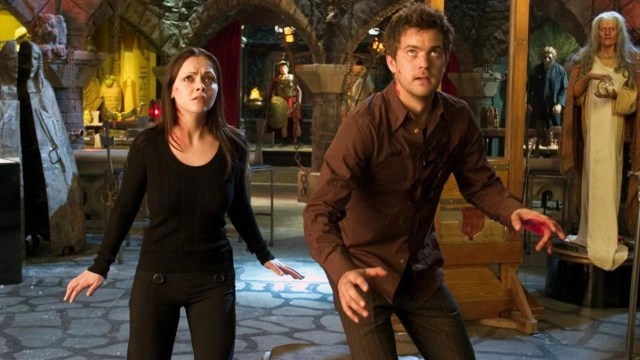
Ellie and Jimmy Myers (Played by Christina Ricci and Jesse Eisenberg respectively) are two orphaned siblings that share a house together and have a somewhat strained relationship. Jimmy is in college while Ellie is an associate producer for a late night TV show. One night while Ellie is driving Jimmy home they hit another car and after recovering and checking on the other car they are both attacked by a monstrous wolf.

Jimmy quickly suspects it is a Werewolf. Ellie though didn’t get a good look and thinks that is Jimmy’s imagination. Despite this, the next day the two begin to experience changes. Their instinct, aggression and strength all seem to have increased. But the changes aren’t stopping there. Jimmy realizes that the Werewolf that attacked them may not want the competition. But who was it? They need to find it, before it finds them! Oh and their dog has the curse too. I have no idea what you call that.

Passing Grade

There is nothing groundbreaking here. The plot is pretty straight forward despite a few swerves on the identity of the Werewolf that attacked them. Having a number of werewolves in the story including the two protagonists dealing with their curse does make it stand out a little, but they don’t really do that much with any of it. The two protagonists get a bit of time each, just enough to show their approaches (Denial Vs Exploration) and how it is impacting them, but little else. The other Werewolves have their identity kept secret and so we never get to explore how they live with the curse. It’s fine, but there were interesting things her that could have been developed.

The protagonists are both likable, which is something often missing in modern horror. Again though they don’t really give us anything new or interesting with them. Given this isn’t a particularly long film it was perhaps a mistake to have two leads, but it’s not a disaster. Craven and Williamson cover everything that needs to be covered and little else. That counts for the whole story, not just the characters. No time is wasted, scenes speed by, often moving on just as they are getting interesting and everything falls into place largely as you would expect it to. The pace means the movie doesn’t drag and it’s well directed and acted the whole way through. The end result is a movie that is reasonably enjoyable, yet also disappointing.

Production Hell

It is worth mentioning that this is a movie that went through it’s own production hell. There are actually at least three very different versions of this movie knocking around in the archives. The first was complete, save for the ending and music. It had very little in common with the released version outside of some of the cast. The movie was then almost entirely re-written and re-shot (Keeping only about 12 minutes) at the behest of Bob and Harvey Weinstein. Part of this seems to have been a desire for a PG-13 rating. The second version, which was complete enough to show audiences in test screenings (And receive a positive reaction), was also largely re-worked after Dimension Films voiced their own complaints.

The first version of the film was a very different story about a serial killer who learns his drive to kill comes from being born with the Werewolf curse. The second version plays up the tragedy side of these movies, something severely lacking in the final version. When seen by people, both versions are always said to be superior to what was released. Still, the final version isn’t all bad. Wes Craven is no stranger to studio interference. He had a similar experience with “Deadly Friend“, with the end result being nothing like he originally intended. At least this time around, the final movie has tonal consistency (Instead of feeling like two different movies glued together).

Conclusion

Overall, this isn’t a bad movie and it does have a Wes Craven feel to it. The acting, characters, plot and effects are all fine. It all works, but you can’t help but feel there was a lot more potential here and it was all wasted. Knowing about the other versions of the story, it seems we almost did get a better movie. Unfortunately, Werewolf movies are hard to get right and it’s no surprise the studio was completely clueless about how to do it. Wes Craven, for his part seems like he did know, but was never able to convince New Line of that. So we got what we got. This is a strong 5.5/10. My original IMDb score was a 4, which I’ve raised to a 6 (Rounding up). I guess it was better second time around.

Rating: 5.5 out of 10.

Bay of Blood (1971)

Time for this years first trip into the world of Italian horror. This is a movie from Gialo legend Mario Bava. If you’ve been following my reviews, you may recall me waxing lyrical about “Blood and Black Lace” (1964). After that I always planned to watch more of his work. I’ve actually only seen three of Bava’s movies, but I always intended to increase that number. This particular movie was recommended to me on X, specifically as a movie that heavily influenced the slasher genre. Too much to pass up here and so I squeezed it in to my October viewing list. The screenplay is from Bava, Giuseppe Zaccariello and Filippo Ottoni. Bava does cinematography here and Stelvio Cipriani provides the music.

one night, at a bayside mansion, Countess “Federica Donati” is murdered. A short while later, the woman’s husband and apparent killer is stabbed to death. A suicide note is left behind for the countess, but the husbands body is missing by the time the police investigate. His daughter “Renata” and her husband “Albert” arrive at the bay to investigate her fathers disappearance. She has an ulterior motive though as the bay was owned by the Countess and she plans to inherit. They aren’t the only people after the bay though as real estate broker Frank Ventura and his lover, Laura are also scheming to buy the land cheap. Then there is the countess’ son (Renata’s step brother), who has been hidden from the world, living in a shack by the bay. As more murders start to happen the question becomes who is hunting who?

Thirteen Corpses

I can definitely see how this was an influence on the slasher genre. Most specifically thought, Friday the 13th (Part one). There is a whole section that is sort of a footnote to the main story, but is straight out of 80’s slasher movies. It’s almost the template for the first four Friday the 13th films, yet it’s only a 20 minute segment of the movie. It’s like other directors watched this and decide it would be even better if this was the entire movie. There’s even a bit of nudity and pre-marital sex in the mix. The rest of the movie has plenty of elements that I can see influenced future slashers, but this particular section stands out.

Of course being Giallo there is no shortage of gore. What makes this different is the faster pace and sheer number of kills. There are thirteen kills, a deliberate number (The kills were written before the story). Friday the 13th didn’t reach that body count until part IV (Exceeding it if you include Jason’s own death). Some of the kills are pretty graphic too, including a beheading that pushed the gore a little bit into the unbelievable territory. Several of these could be seen as direct influences on similar deaths within the Friday the 13th franchise. Speaking of that number (Thirteen), it’s especially relevant here as the events all kick off on the 13th. The day isn’t specified, but it could well be a Friday.

The Art of the Slasher

Bava is his own cinematographer here, and so he gets the credit for the creative filming. I especially took note of his use taking the camera out-of-focus. Bava does this throughout, sometimes through zooming, but not always. Many times this is used for a transitions. The technique helps to give the film as smooth flow instead of making hard cuts. This makes the film seem both artistic, but also a little like found footage. Another slasher element on display here is the occasional use of the first person. It is used sparingly, but effectively. Bava was forced to finish the film with a minimal budget and so it’s no surprise a lot of what he came up with ended up as standard techniques for low budget slashers.

There’s plenty of jump scares too, usually the kills come out of nowhere. Being the first of it’s kind it’s not a surprise that there aren’t any false jumps (Something that would become a mainstay of future slashers). The main difference between Bay and most slashers is (Spoiler) there are multiple killers. I won’t elaborate too much on that since that would be major spoilers, but this isn’t a folk law killer wiping everyone out. Perhaps the most interesting thing here is that visually this is a step away from what you expect from giallo. Indeed, I’m not sure it can even be classified as such. This truly is a slasher film or at least half way between the two.

Conclusion

There are however, flaws. Most of which involve the plot. The ending is frankly a bit silly and there is at least one murder that doesn’t seem to make much sense logistically. Honestly, I think this has a plot that falls apart the more you think about it. But then, this is a slasher, what did I expect? In regards to the characters, they all seemed to have personalities. Even those doomed to a short life expectancy. I wouldn’t really call it depth, but Bava at least attempts to make them seem human, which is more than I can say for some modern slashers. The acting too is decent and despite being an Italian horror, I didn’t notice any awkward dubbing.

It’s not necessarily by design that this is a proto-slasher, instead, it’s likely a result of production issues. As a slasher, the overly convoluted plots means it lacks focus. But as a giallo it lacks flair. Overall though, while not as visually stunning as Blood and Black lace, this is a groundbreaking movie. It still stands the test of time as a solid and unique slasher film, even by modern standards. It is worthy of a strong 6.5/10. This is a must see for slasher and giallo fans alike. If you aren’t a fan of either sub-genre, then it’s a mild recommendation instead.

Rating: 6.5 out of 10.